Powered by Blogger.
Showing posts with label AT&T. Show all posts

AT&T Mulls Reinvention for Web With $86 Billion Time Warner Deal


Time Warner Inc. and AT&T Inc., companies that over the decades have survived the shift to talkies, color TV and cable, are contemplating a merger to adapt to the latest technological shifts: smartphones and streaming.
More consumers are getting their entertainment online from Netflix Inc. and watching on iPhones instead of TVs. That’s putting pressure on traditional entertainment companies and pay-TV providers. For many, it’s no longer enough just to make TV shows or own a cable company.
“You need to do both,” said Chris Marangi, co-chief investment officer at Gamco Investors Inc., which owns stock in both companies.

That logic is driving Dallas-based AT&T’s effort to buy Time Warner as two storied companies respond to changes reshaping the entertainment industry in 2016. AT&T, founded in 1885, is close to an agreement to buy the parent of the 93-year-old Warner Bros. film studio for about $110 a share, or an estimated $86 billion. An agreement could be approved Sunday and announced as soon as Monday, according to people with knowledge of the matter. The talks are ongoing and a deal could still fall through, the people said.

Pay-TV distributors like AT&T, the parent of DirecTV, are trying to prevent subscribers from dropping their services for cheaper online alternatives. They aim to own content they can offer wherever consumers want, whether it’s streamed to mobile phones or broadcast on TV.
AT&T’s chief rival, Verizon Communications Inc., has sized up in the challenge in a different way, opting for original programming designed specifically to be viewed on smartphones for its mobile video service, Go90. Verizon has been buying up companies like AOL and Yahoo! Inc. to become a player in the mobile advertising market.
New York-based Time Warner, which also owns CNN and HBO, is a rich target for AT&T. The media company has a vast library of movies and television series, such as the “Harry Potter” films and “Game of Thrones,” and is among Hollywood’s most prolific producers. Its annual revenue totals $28 billion.

Pressure to Sell

AT&T’s interest “demonstrates the embedded value of media content in distribution platforms,” said Steven Cahall, an analyst at RBC Capital Markets.
The same industry pressures may explain Time Warner’s willingness to sell -- two years after rejecting a buyout offer from 21st Century Fox Inc. Time Warner, Walt Disney Co. and competitors like Viacom Inc. are all confronting similar threats: falling TV ratings as consumers drop or pare their cable-TV subscriptions for online alternatives.
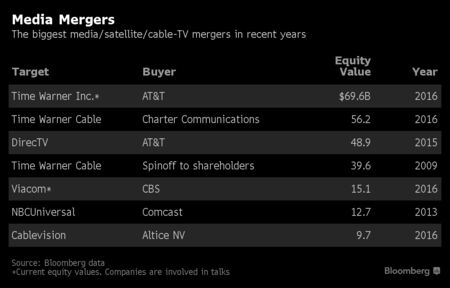
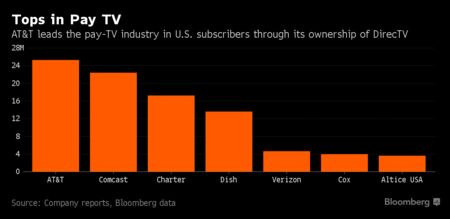
The pay-TV distributors have been combining as well, building negotiating leverage to rein in the price increases media companies seek for their TV networks. AT&T bought DirecTV last year for $48 billion, creating the biggest U.S. pay-TV service, while Charter Communications Inc. did a $56 billion deal to swallow up Time Warner Cable Inc. -- a former unit of Time Warner.


“Time Warner is saying maybe there are limits to what they can do as a standalone entity,” said Marangi. A deal between the company and AT&T “could be the match that gets consolidation going on the content side.”
Some deals are already in the works. CBS Corp. and Viacom Inc., controlled by billionaire Sumner Redstone and his daughter Shari, are considering recombining after more than a decade as separate companies. In June, Lions Gate Entertainment Corp., the studio behind “Mad Men” and “The Hunger Games,” agreed to buy the premium cable network Starz, beating out a rival bidder -- AT&T.
Separately, both AT&T and Time Warner have been responding to the consumer’s desire to watch more movies and TV shows online. AT&T plans to unveil a new web-streaming TV service, DirecTV Now, that will carry dozens of cable channels over the internet. Time Warner’s HBO last year introduced an online version of its network for people who don’t want cable TV.

Unparalleled Scale

With Time Warner, AT&T would combine distribution and production on a scale unparalleled in traditional media, potentially creating new options. The phone giant already owns the second-biggest U.S. wireless network and the largest U.S. pay-TV footprint. The deal would make it one of the largest producers of entertainment as well.
Such a combination is certain to face intense regulatory scrutiny. When it bought NBCUniversal, Comcast Corp. had to accept conditions so it wouldn’t be too powerful in the burgeoning web TV landscape. NBC was required to make all of its channels available to all new online TV entrants, weakening its negotiating leverage.
The entertainment division also was barred from exerting influence on the streaming service Hulu, which it partly owns. Hulu will soon unveil an online TV offering that competes with Comcast’s conventional cable service.
Analysts are divided over how valuable the NBC deal has been for Comcast and whether it makes sense for AT&T to own TV networks and production studios. While Comcast’s Universal film studio just had its best year ever, the company’s cable business has lost subscribers and some of NBC’s networks have seen audience ratings fall.

The Internet of Drones Is Coming


Commercial aviation was born in the later years of World War I, and so too was the need for air traffic control. With a sudden post-war excess of military aircraft, Britain and France began converting their light, reliable bombers into mail planes. Consequently, air traffic density all of a sudden became an imminent hazard, a congested airscape whose danger peaked in 1922, when a Farman Goliath and a De Havilland DH-18 collided 60 nautical miles north of Paris, killing all on board.
Regulators and authorities responded by instituting air traffic corridors and beacon-based navigation systems—and eventually, around 1930, air traffic control towers began appearing in the UK. In 1935, the first Flight Monitoring Center appeared in Newark. It consisted of a clock, a notepad, some navigation charts, and a not-particularly-reliable radio setup. In a couple of decades there would be radar, too.
We can imagine the current state of drone affairs as analogous to the pre-ATC days of manned aviation. Suddenly, drones are cheap enough for hobbyists and advanced enough to conceivably be used for goods delivery, e.g. Amazon drones, pizza drones, etc. But a significant barrier remains in the form of drone traffic density. How do you keep your pizza drones from smashing into your news drones from smashing into your hobbyist drones?
As described in a paper published this week in IEEE Internet Computing, courtesy of Robert J Hall at AT&T Labs, the answer lies in an "internet of drones." Drones can best avoid each other if they know about each other, and this is the essence of Hall's Geocast Air Operations Framework (GAOF) prototype.
"The goal of the work is to demonstrate a path toward an improved system for the operation of drones, with the necessary secure command and control among all legitimate stakeholders, including drone operator, FAA, law enforcement, and private property owners and citizens," Hall writes. "While today there are drones and drone capabilities that work well with one drone operating in an area using a good communication link, there will be increased challenges when there are tens or hundreds of drones in an area."
GAOF is an extension of an existing AT&T technology known just as the Geocast System, which is being tested for similar traffic management applications on the ground, e.g. for people and cars. Obviously, adding a third dimension makes things a bit more complex.
The problem, however, is difficult whether we're talking about driverless cars or drones for the simple reason that an ideal medium doesn't exist for connecting them. Cellular networks are obvious, but these can change and drop out as a drone moves from place to place. Wireless ad-hoc networks, where drones connect to each other peer-to-peer, are an obvious solution, but carry with them the limitation of not being connected to the greater internet. This prevents the drones from accessing information about drones that are not within line-of-sight (and so can't be reached with a peer-to-peer wireless network), and general information about local airspace restrictions, should they exist.
The Geocast system works by automatically flipping between the two network tiers depending on availability. Crucially, should it only be able to access a an ad-hoc network, it can gain access to the greater internet via packets relayed via other drones.
"So, for example, if one drone has both tiers available, it can act as a relay, transferring long-range packets into the short-range tier (or vice versa), so that a single-tier drone can receive messages that come via the relay from sources on the other tier," Hall explains. "This is useful in many scenarios; for example, one could orbit a two-tier-capable drone at higher altitude above an area of operations in a valley where cell coverage was nonexistent, allowing remote awareness and control of drones operating at lower altitude within the valley."
The drone traffic control problem gets still more interesting. How in the first place can we send packets to a three-dimensional geographical space—that is, every drone within that space—rather than to a list of specific drone IP addresses?
The answer is in geographic addressing (GA), in which circles centered around different latitudes and longitudes are assigned their own address, which is shared among all drones within that circle. Every device that wishes to monitor an area comes with up a query message, which is then sent to a specific geographic address. The drones within that address region send their replies back to the geographic address of the querying drone. All of the said drone's neighbors get the reply, but if they know they didn't send the query, it's easy enough to just ignore it.
(This is a lot like how subnets work on the internet: Your computer sends and receives the same internet traffic as everyone else sharing the same network access point, it just filters it all down to the stuff meant for you.)
As Hall explains, this sort of collision avoidance could be extended beyond other drones and to buildings and towers and other things to be avoided. It's just a matter of outfitting them with a beacon connected to a geographic address.
"This prototype system has been implemented and tested using simulated drones," Hall notes. "Aerial field testing with real drones is being planned and will be conducted in accordance with the FAA guidelines."

IoT revenues up 15%; cloud computing a big driver


A new report shows healthy revenues for 21 benchmarked Internet of Things (IoT) companies in the last quarter of 2015, with revenue growing by almost 15% to levels approaching $7 billion. Cloud computing and IT infrastructure are especially potent drivers of IoT revenues, as vendors help companies cope with ever increasing rivers of data.

In a press release Technology Business Research (TBR) reported that commercial IoT opportunities drove year-over-year growth in the fourth quarter by 14.8% among the 21 companies it tracks in its regular Commercial IoT Benchmark report. Total revenues for the quarter were $6.7 billion among benchmarked vendors that include Verizon, Microsoft, Intel, Google, Amazon, Siemens, Cisco, Ericsson and Oracle.
See also: Hackers drive huge growth in IoT security market
“Effectively, every type of IT and operational technology (OT) vendor will have a stake in the growing commercial IoT market, as IoT solutions will drive increased use of diverse IT and OT products and services,” said Dan Callahan, a TBR analyst specializing in devices and IoT.

TBR says revenue growth is being driven by a rise in go-to-market refreshes by top vendors who are striving to become known as early leaders in the commercial IoT space.
“In addition to building interest in established IT products, commercial IoT will create growth in specialized business consulting, hardware, network, development, management and security components,” said Callahan. “IT and OT vendors that are quick to capture IoT opportunities within their current customer base, and attract new ones through developer programs and investing in growing mindshare, will enjoy additional, immediate, revenue opportunities.”


Revenues driven by explosive growth in data management needs

TBR’s report showed vendors are looking to become early IoT leaders in order to drive profits in this emerging industry. Vendors who take an early IoT leadership position are benefiting because there is less competition, customers have limited outsourcing options due to early IoT’s security challenges, and clients require custom solutions due to the lack of technology standards.
Cloud computing services posted the highest year-over-year revenue growth rate of 79% to record $604 million in the quarter. This growth is being propelled by the vastly increasing need being created for platforms to process and store data.

TSR also noted strong growth in IT services and ICT infrastructure, which charted a 51.4% growth rate in revenue for the quarter. This subsector is benefiting from the increasing capacity requirements created by the huge streams of IoT data that is being generated, as more companies struggle to tame the growing flood of information into actionable insights.

Verizon, AT&T to Issue Government Transparency Reports

Verizon

All it took was six months and some of the worst press any corporation could possibly have. Verizon and AT&T will finally begin issuing transparency reports of government requests for their data.
It's a striking move for both companies and privacy advocates at the Electronic Frontier Foundation said they were "pleasantly surprised" by the move. Verizon was the centerpiece of the very first of former National Security Agency contractor Edward Snowden's revelations: that the NSA regularly got the call records of all Verizon's customers via secret court order.
When American tech companies like Google, Yahoo and Facebook were soon similarly indicted with documents proving they were tapped in a program called PRISM, they sprung into action. Each issued carefully worded denials that they were willing participants in such a scheme, and already published transparency reports — fuzzed on the specifics, per government demand — of how much information that governments around the world, including the U.S., demanded of them.
The phone companies, however, made no such gestures at the time. One Verizon executive dismissed the tech companies' actions as "grandstanding," adding that they "wave their arms and protest loudly so as not to offend the sensibility of their customers."
It's not hard to guess what might have prompted their change of heart. Both companies received letters from major shareholder groups in November, demanding the companies be more transparent.
Both companies said they'd provide a breakdown of government requests and court orders for their customers' information by early 2014.
However, it's not all roses for privacy advocates. AT&T specifically noted it would not include classified orders from the Foreign Intelligence Surveillance Court (FISC), the type made by the NSA. Verizon didn't address that issue in its own press release, and a representative contacted by the Daily Dot didn't immediately return request for comment. (In fairness, it is Christmas Eve.)

Police Made 1.1 Million Data Requests to Cellphone Carriers in 2012

Police Made 1.1 Million Data Requests to Cellphone Carriers in 2012

Wirelesscarriers

After the summer's string of revelations about NSA surveillance, companies like Google, Facebook and Microsoft have united in protest, published transparency reports and asked for permission to reveal even more information.
Cellphone companies like Verizon or AT&T have thus far remained silent when it comes to NSA. Major carriers are, however, now revealing that they received 1.1 million data requests from local law enforcement agencies in 2012, including requests for location data, text messages, browsing history and call logs.

Google, Microsoft Lead Campaign to Limit Government Surveillance
The data, which does not include NSA or national security-related investigations, was revealed on Monday by the seven major U.S. cellphone carriers, answering a series of questions posed by Sen. Ed Markey (D-Mass.). Their answers open a small window into how AT&T, Verizon, Sprint, T-Mobile and others collaborate with police across the country.
The 1.1 million number refers to the number of requests the companies received, not necessarily how many they responded to. AT&T, however, reported that it denied only 1,300 out of a total of 297,500 requests, while Verizon said it "does not track" whether they provided the requested data or not.
By comparison, in 2011, based on numbers also reported at Markey's behest, carriers received 1.3 million data requests. But that number isn't directly comparable to this year's total, since Sprint refused to reveal data this time around, arguing that its systems make it impossible to reveal such a number.
The telecoms also reported 9,000 so-called "cellphone towers dumps," where cops ask for all phone numbers that connected to one or more towers at certain times, which could affect hundreds of thousands of phone numbers, revealing customers' precise locations at a certain point in time.
As it turns out, one in four law enforcement agencies have used cell tower dumps, according to a report published on Sunday by USA Today.
The carriers' reports also revealed that not all companies require warrants when releasing customer data.
For example, AT&T doesn't require a warrant when releasing historical (i.e., not real-time) cellphone location data, only a simple court order. And the content of text messages older than 180 days is released by AT&T with a court order or a subpoena. Verizon requires a signed court order or a search warrant for historical data, but doesn't provide real-time location data at all, and it always requires a warrant for the content of texts.
"If the police want to know where you are, we should know why,” said Markey in a statement. "When law enforcement access location information, it's as sensitive and personal as searching an individual’s home and should be treated commensurately."
For Markey, these numbers and the carriers' varying practices are cause for concern, and they underscore the need for privacy reforms.
"As law enforcement uses new technology to protect the public from harm, we also must protect the information of innocent Americans from misuse," Markey said in a statement. "We need a 4th Amendment for the 21st century. Disclosure of personal information from wireless devices raises significant legal and privacy concerns, particularly for innocent consumers." Markey also announced he plans to introduce his own legislation to add warrant requirements to such data requests.
During the last year, Montana and Maine were the first states to make warrants a requirement when cops request cellphone location, and the New Jersey Supreme Court ruled along the same lines as well.
The USA Today investigation also revealed that 25 police departments own Stingray devices, machines the size of a suitcase that act as cell towers and can surreptitiously track cellphone users' locations and intercept conversations by tricking cellphones into connecting to them.
36 more police departments, however, declined to disclose if they've ever used Stingrays, or if they have ever requested cellphone tower dumps.
Both Stingrays and cell tower dumps are criticized by privacy advocates for their wide reach. To target one or a few suspects, critics say, police end up gathering information on thousands of unrelated customers. Stingrays, which are also called IMSI catchers, intercept data from all phones within a mile, according to USA Today.
Privacy and digital liberties advocates have also pointed out that the use of these devices is often secret, and there's no clear regulation limiting their use.
Markey's inquiry also revealed how much the U.S. law enforcement agencies have paid carriers for their surveillance requests. AT&T received a $10 million reimbursement, T-Mobile got $11 million, and Verizon was paid slightly less than $5 million.
Finally, the companies' practices differ also in how long they retain these types of data — which determines how far back in time cops can go. Most retain data for six to 18 months, but AT&T keeps data for up to five years.