Powered by Blogger.
Showing posts with label News. Show all posts

AT&T Mulls Reinvention for Web With $86 Billion Time Warner Deal


Time Warner Inc. and AT&T Inc., companies that over the decades have survived the shift to talkies, color TV and cable, are contemplating a merger to adapt to the latest technological shifts: smartphones and streaming.
More consumers are getting their entertainment online from Netflix Inc. and watching on iPhones instead of TVs. That’s putting pressure on traditional entertainment companies and pay-TV providers. For many, it’s no longer enough just to make TV shows or own a cable company.
“You need to do both,” said Chris Marangi, co-chief investment officer at Gamco Investors Inc., which owns stock in both companies.

That logic is driving Dallas-based AT&T’s effort to buy Time Warner as two storied companies respond to changes reshaping the entertainment industry in 2016. AT&T, founded in 1885, is close to an agreement to buy the parent of the 93-year-old Warner Bros. film studio for about $110 a share, or an estimated $86 billion. An agreement could be approved Sunday and announced as soon as Monday, according to people with knowledge of the matter. The talks are ongoing and a deal could still fall through, the people said.

Pay-TV distributors like AT&T, the parent of DirecTV, are trying to prevent subscribers from dropping their services for cheaper online alternatives. They aim to own content they can offer wherever consumers want, whether it’s streamed to mobile phones or broadcast on TV.
AT&T’s chief rival, Verizon Communications Inc., has sized up in the challenge in a different way, opting for original programming designed specifically to be viewed on smartphones for its mobile video service, Go90. Verizon has been buying up companies like AOL and Yahoo! Inc. to become a player in the mobile advertising market.
New York-based Time Warner, which also owns CNN and HBO, is a rich target for AT&T. The media company has a vast library of movies and television series, such as the “Harry Potter” films and “Game of Thrones,” and is among Hollywood’s most prolific producers. Its annual revenue totals $28 billion.

Pressure to Sell

AT&T’s interest “demonstrates the embedded value of media content in distribution platforms,” said Steven Cahall, an analyst at RBC Capital Markets.
The same industry pressures may explain Time Warner’s willingness to sell -- two years after rejecting a buyout offer from 21st Century Fox Inc. Time Warner, Walt Disney Co. and competitors like Viacom Inc. are all confronting similar threats: falling TV ratings as consumers drop or pare their cable-TV subscriptions for online alternatives.
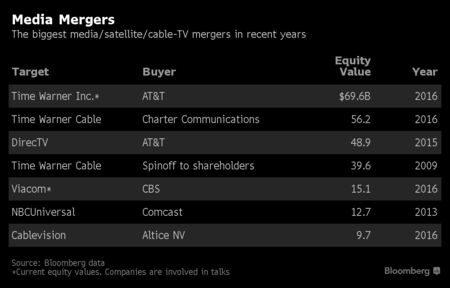
The pay-TV distributors have been combining as well, building negotiating leverage to rein in the price increases media companies seek for their TV networks. AT&T bought DirecTV last year for $48 billion, creating the biggest U.S. pay-TV service, while Charter Communications Inc. did a $56 billion deal to swallow up Time Warner Cable Inc. -- a former unit of Time Warner.


“Time Warner is saying maybe there are limits to what they can do as a standalone entity,” said Marangi. A deal between the company and AT&T “could be the match that gets consolidation going on the content side.”
Some deals are already in the works. CBS Corp. and Viacom Inc., controlled by billionaire Sumner Redstone and his daughter Shari, are considering recombining after more than a decade as separate companies. In June, Lions Gate Entertainment Corp., the studio behind “Mad Men” and “The Hunger Games,” agreed to buy the premium cable network Starz, beating out a rival bidder -- AT&T.
Separately, both AT&T and Time Warner have been responding to the consumer’s desire to watch more movies and TV shows online. AT&T plans to unveil a new web-streaming TV service, DirecTV Now, that will carry dozens of cable channels over the internet. Time Warner’s HBO last year introduced an online version of its network for people who don’t want cable TV.

Unparalleled Scale

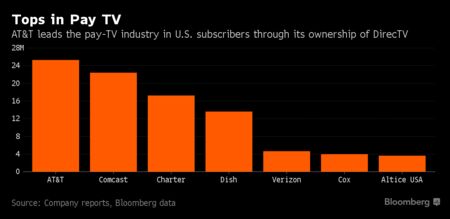
With Time Warner, AT&T would combine distribution and production on a scale unparalleled in traditional media, potentially creating new options. The phone giant already owns the second-biggest U.S. wireless network and the largest U.S. pay-TV footprint. The deal would make it one of the largest producers of entertainment as well.
Such a combination is certain to face intense regulatory scrutiny. When it bought NBCUniversal, Comcast Corp. had to accept conditions so it wouldn’t be too powerful in the burgeoning web TV landscape. NBC was required to make all of its channels available to all new online TV entrants, weakening its negotiating leverage.
The entertainment division also was barred from exerting influence on the streaming service Hulu, which it partly owns. Hulu will soon unveil an online TV offering that competes with Comcast’s conventional cable service.
Analysts are divided over how valuable the NBC deal has been for Comcast and whether it makes sense for AT&T to own TV networks and production studios. While Comcast’s Universal film studio just had its best year ever, the company’s cable business has lost subscribers and some of NBC’s networks have seen audience ratings fall.

$47 billion offer to create world's biggest tobacco company


British American Tobacco has offered to buy out Reynolds American Inc. for $47 billion in an attempt to gain a strong presence in the U.S., a lucrative market where sales of electronic cigarettes are booming as traditional smoking fades.
The takeover would create the world's largest publicly traded tobacco company and combine BAT's presence in developing countries, where anti-smoking campaigns are not as strong as in the U.S. and Europe, with Reynolds' almost exclusive focus on the U.S.
BAT already owns 42 percent of Reynolds and sells Dunhill, Rothmans and Lucky Strike cigarettes. Reynolds controls about a third of the U.S. market with brands like Newport, Camel and Pall Mall.
Though smoking in the U.S. is declining, it remains "the largest global profit pool" outside of China, BAT said in a statement Friday. The U.S. is one of the biggest markets for e-cigarettes.
"BAT and Reynolds American have a strong existing relationship, and while cost savings will be relatively modest, the full access this acquisition would give BAT to the U.S. — a lucrative, consolidated market with high barriers to entry — means it makes eminent sense," Shane MacGuill, head of tobacco at Euromonitor International, said by e-mail.
The British company offered Friday to buy the Reynolds shares it doesn't already own for the equivalent of $56.50 each, 20 percent more than Thursday's closing price. Investors would receive $24.13 in cash and 0.5502 of a BAT share for each Reynolds share they own. That values Reynolds, based in Winston Salem, North Carolina, at $93 billion.
Reynolds shares jumped 13.5 percent to $53.50 in in New York, while BAT edged down 0.3 percent to 47.88 pounds in London.
The deal is the latest attempted merger in the industry as tobacco companies face weakening demand in developed markets. Only last year, Reynolds American acquired Lorillard, the maker of Newport, the U.S.'s best-selling menthol cigarette brand.
Reynolds traces its roots to 1875, when Richard Joshua Reynolds started a chewing tobacco company in what was then Winston, North Carolina. The company's links with British American Tobacco date to 2004, when R.J. Reynolds Tobacco Co. merged with BAT's Brown & Williamson unit, creating Reynolds American. BAT was left with a 42 percent stake in the new company.
The two companies already have a technology-sharing agreement in the development of electronic cigarettes.
The merger "is the logical progression in our relationship and offers all shareholders a stake in a stronger, truly global tobacco and next generation products company," Chief Executive Nicandro Durante said in a statement.
Reynolds said in a statement that it will evaluate the offer.
Tobacco companies are particularly keen to expand in developing countries to make up for weaker sales in Europe and the U.S. The industry has been grappling with widespread anti-smoking campaigns that have forced companies like BAT and Reynolds to diversify into nicotine replacements and e-cigarettes to meet consumer health concerns.
It also comes only months after Britain instituted plain packaging rules for cigarettes. The idea is to ruin the allure of cigarettes created by advertising and prevent a new generation from taking up the habit.
Reynolds warned in a 2016 filing that if its companies "are not able to develop, produce or market new alternative products profitably, the results of operations, cash flows and financial positions ... could be adversely affected."
"The markets in which these firms are the dominant players are declining, and they face ever increasing competition from Asia in seeking to develop new markets," said Nigel Driffield, professor of international business at Warwick Business School in England.
Asian tobacco companies face less public pressure over increasing sales in developing markets, where public health regulation may not be as strict, he said.
But the U.S. remains an important market. Owen Bennett, an equity analyst at Jefferies International, underscored that the United States currently accounts for 45 percent of global sales of e-cigarettes, also known as vapor cigarettes.
"If vapor accelerates as we expect, then the U.S. is the place to be," he said. "The deal would also give BAT the best exposure to global e-vapor development."
BAT employs more than 50,000 people globally while Reynolds employs 5,700, mostly in the U.S.
The planned merger would create a company likely to overtake Philip Morris International Inc. as the world's biggest publicly traded tobacco company. But China's National Tobacco Corp. is bigger than BAT and Reynolds both combined, Euromonitor International data showed.
BAT, founded in 1902, sold 663 billion cigarettes in more than 200 countries last year and generated revenue of 13.1 billion pounds ($16 billion). Reynolds shipped 76 billion cigarettes last year and reported sales of $10.7 billion.

Read more here: http://www.sacbee.com/latest-news/article109591157.html#storylink=cpy

The Doctors Who Did the First US Penis Transplant Explain How It All Works


On Mother’s Day, a team of scientists at Massachusetts General Hospital successfullyperformed the first-ever penis transplant in the United States.
Plastic surgeons Curtis Cetrulo and Dicken Ko performed the 15-hour operation on Thomas Manning, a 64-year-old who lost the vast majority of his penis in order to cure him of his cancer.
There have been two other penis transplants—one in China in 2006 that failed, and a successful one in South Africa in 2014.
Though penis transplants have thus far been rare, urotrauma is not. Cartel and Ko say that there are many young men—many of them military veterans—languishing in silence without their penises because of injuries sustained in Iraq or Afghanistan.
And so Cetrulo, Ko, and Manning have decided to be very public about the surgery in hopes that the procedure becomes more common. As you might expect, there’s a lot that goes into transplanting a penis. It’s a technically difficult surgery that Cetrulo says is a “quantum leap” beyond current options for those who have a penis amputation, which often involve “taking soft tissue from the arm or leg and wrapping it in a tube and basically placing a catheter through the center to make it look genitalia-like.”
Cetrulo and Ko say that first and foremost, they want Manning’s penis to look like a normal penis. Secondarily, they want him to be able to pee standing up—now, “he just sprays,” Ko told me. Finally, they want him to be able to regain normal sexual function. He’ll be working with a sexual medicine therapist over the coming months on that last goal.

"Connecting the urethra is not that difficult. We know how to do it from the reconstruction of urethras, which are injured in a lot of other circumstances"

I spoke to the doctors to learn how the donor penis was chosen, Manning’s state of mind, and how, exactly, one transplants a penis.
MOTHERBOARD: How does a penis transplant work? What made you want to do this in the first place?
Cetrulo: We see this as a continuum of other transplants such as hand transplantation and face transplantation.
These are all called “vascularized composite allographs,” which are organs made up of skin and more than one type of tissue. With a kidney, it’s all kidney. But with a hand it’s tendons, nerves, blood vessels, which are vascularized. Allographed just means it’s from a different person.
It sort of follows logically that the intricacy of the genital urinary system lends itself to a transplant that is more similar to these sorts of vascularized composite transplants. It’s technically more difficult than a hand transplant because, vascularly, it’s more technically challenging.
So what is the order of operations then? What makes it more difficult than a hand?Ko: The urethra is the largest structure in reconstruction, that’s what needs to be secured first. It’s kind of forms a large scaffolding for the rest of the surgery. All the other things are wiring—you’re creating a network that makes the penis allograph work.

There are many different veins and arteries in the penis. Image: baus.org.uk
Connecting the urethra is not that difficult—we know how to do it from the reconstruction of urethras, which are injured in a lot of other circumstances. It’s not the newest technology there. The urethra is put together and forms an anchor. We have a catheter in the bladder, and then it’s a much more delicate procedure to proceed and connect all the vascular tissue and the nerves.

He said, "Anything to just help me out would be a wonderful opportunity. The key is to have the opportunity to become whole again so I can look myself in the mirror"

It sounds as though this was successful, at least so far. He will be able to have full function eventually, right?Ko: There are three goals established in this order: Number one is appearance. We want him to have full genitalia that looks as normal and natural as possible. Two is genital urinary function, so he can void normally while standing up. The third benchmark is whether these patients can develop full sexual function. That will take a lot of time before we know.
What is the rehab process like?Cetrulo: He’ll engage with a urological team to make sure he gets urinary function when the catheter comes out. Then we have a sexual medicine expert, she’ll be a very important part of his care going forward as he tries to reestablish sexual function. We’ll spend a lot of time on that because this is one of the biggest goals of our transplant. He’ll require support psychologically.
Will his sexual partners be able to tell that he’s had a transplant?Cetrulo: We’re hopeful that it’ll be pretty inconspicuous. He’ll have scars in the region but it’ll look like what it is, which is full genitalia.

"The suicide rate in this population is somewhere between 15 and 50 percent"

How does the donation process work? Where do you find a penis donor?Cetrulo: The donors are selected by organ procurement organization called the New England Organ Bank. They had a separate protocol they used to approach families to find a potential donor [for the penis]. They call the hospital when one is identified.
It’s just like when other organ transplant teams are alerted. We worked with them to obtain the tissue we need, with the caveat that we certainly don’t get in the way of life saving organs for others.
Did you have to find a penis that was roughly the same size as the one he had?Cetrulo: Yeah, there’s things we can do with the anatomy to tailor the tissue to match the recipient donor. There’s a little leeway there, but we needed a match with room for a minor discrepancy.
And do you have to worry about things like blood type? How do you know if he’ll reject it or not?Ko: It’s a blood-type identical donor-recipient organ. So we tested our recipient for anti donor antibodies, of which there were none. So he can take most donors without a high risk of hyper acute rejection.

"If he stands up to pee, he just sprays"

You mentioned in the New York Times article that you’re being so public about this because you want this to become more common—what did it take in this case to get it done? Is it fair to call this a proof of concept?Cetrulo: We’re hoping it’ll become more routine. It takes a while to get through the ethics approval board and things like this. We’re not dragging our feet—we think we can do it but there’s a lot of hurdles that need to be overcome, which is why we started with our own patients here. We hope we’ll do it successfully so we can begin reconstructing wounded warriors.
It’s more than a proof of concept. We call it an index case in that it’s our first one, but we’re hyper prepared and hyper vigilant and we expect it to go well. We hope the first one goes as well as our next 100.
From reading that article, the patient seems like an amazing person. What can you tell me about his attitude through all this?Ko: He’s an amazing man. Four years ago when he lost a large portion of his penis, it was hard for him. Before the cancer, the man was totally functional, but he lost his ability to urinate properly. If he stands up to pee, he just sprays.
He lost sexual function, he became much much more withdrawn. When the opportunity for this came out, he said, “Anything to just help me out would be a wonderful opportunity. The key is to have the opportunity to become whole again so I can look myself in the mirror.” It’s something society has had a changing attitude on—a holistic type of medicine. We’re treating the form and we’re treating function. Part of that is his mental health. It’s a tribute to the man behind the disease.
Cetrulo: The inspiration for this was a colleague’s experience at Walter Reed [Army Medical Center].
Young kids coming back from Iraq and Afghanistan in the urologic trauma ward with devastating injuries one after another. He’s a grizzled and experienced surgeon who had seen bad urologic injuries, but he wasn’t prepared for this. He said we have to do this for these patients. It was a patient-driven project and continues to be. It’s inspiring to talk to these patients who were suffering from these injuries in silence, they were so uncomfortable they couldn’t even talk about it with buddies and friends and spouses. The suicide rate in this population is somewhere between 15 and 50 percent. As you can imagine an 18 to 20 year old kid coming back without any genital urinary function is prone to being quite hopeless.
Before transplantation, were there any other options? Like prosthetics, or what?Cetrulo: The reconstructive option we used to use was to take soft tissue from the arm or leg and wrap it in a tube and basically place a catheter through the center and make it look genitalia-like.
It accomplishes in a rudimentary fashion the first two goals we talked about. Sometimes you can pee standing up, other times you cannot. But it doesn’t function like a sophisticated anatomic tissue. This is a quantum leap as far as we’re concerned.

Hacker Claims to Have Full Control of Pornhub, Offers Access For $1,000


A 19-year-old hacker claims to have hacked into Pornhub’s server and is trying to sell the access for $1,000.
The hacker, who goes by the name Revolver, posted two pictures on his Twitter to prove he had access to Pornhub’s server. The alleged breach comes less than a week after Pornhub launched a bug bounty program to encourage friendly hackers to report flaws and vulnerabilities into the site and help get them fixed.
But Revolver didn’t seem interested in taking that road.
“I don't report vulnerabilities anymore,” Revolver tweeted. “Go underground or go away #FuckBugBounty.”
Revolver told me in an online chat that he hates bug bounty programs because in the past he ”reported a lot of bugs but got no reply from companies,” and he doesn't like to give companies his real name.
The hacker told CSO Online, which first reported the story, that he was able to upload a shell, essentially a control panel he could use to issue any commands on a Pornhub’s server. If true, in other words, Revolver had full control over the server. Revolver said he took advantage of a vulnerability in Pornhub’s “user profile script that handles image uploads.”
Pornhub did not respond to a request for comment, but said on Twitter that it was investigating and that “it doesn't seem like access was gained to a production server.”

“I don't report vulnerabilities anymore. Go underground or go away #FuckBugBounty.”

On Sunday, the hacker told Motherboard that he had already sold the access to three people. He also said Pornhub reached out to him via Twitter but he has still to hear back from them.
”I will tell them they can go fuck off," he said, adding that, however, ”if they gave me a premium account I'm ready to help them fix that.”
Revolver has been quite busy in the last few weeks. In April, he reported a bug in the website to the Freedom of The Press Foundation, which earned him a public thank you from Edward Snowden. He also claimed to have found a bug into the website of the embattled Panamanian law firm Mossack Fonseca, which has been at the center of the Panama Papers scandal. And in a similar incident to this Pornhub one, he also offered access to the LA Times website,
In March, Revolver created a site that displayed screenshots and IP address of random people’s hackable computers, which he called VNC Roulette.

Pinterest Is Gaining Ground on Facebook and Twitter for News

Pinterest Is Gaining Ground on Facebook and Twitter for NewsPinterest

When it comes to sharing news online, Facebook and Twitter get most of the attention. Pinterest, a platform more traditionally known for retail, food and travel-related postings, is gaining ground in the news category as well.
A new study from Gigya, a social login provider for many media companies, including ABC, NBC, and FOX, found that 20% of all "media/publishing"-related content shared to social networks in Q3 was shared on Pinterest. Facebook (40%) and Twitter (30%) maintained leads in the category, but Pinterest gained some ground after accounting for 18% of media and publishing shares in Q2.

Pinterest also claimed a higher percentage of social media shares in other categories, including 44% of ecommerce-related shares, higher than any other social network. The chart below shows the media/publishing social shares for the third quarter of 2013.
A pie graph depicting "media/publishing" social shares in Q3 2013.
A social share means that a user utilized a page's share plugin or clicked on the "share" button, which is often located near the top of the page. Thus, Gigya's data does not include instances where users share by copy and paste. The company has more than 700 clients, including Gannett and Hearst, so the data incorporates a significant sample size.
Many now get their news on social networks. A Pew Research study released in October found that 30% of U.S. adults find their news on Facebook. Gigya's data was released just a few days after Facebook announced changes to its News Feed algorithm in an attempt to surface more "high quality" content for users.
Pinterest also made changes in September to encourage users to upload article pins. Articles posted to the site now include more details like the title, author and short description of the article.

9 Essential Twitter Sources for Ukrainian Conflict News

9 Essential Twitter Sources for Ukrainian Conflict NewsUkraineprotests

Events in the Ukrainian capital of Kiev have moved rapidly over the past week or so. Not surprisingly, Twitter and other social channels have often been the most up-to-date sources of information on the unfolding conflict.
In a nutshell, the tension there revolves around President Viktor Yanukovych's abrupt decision to reject a broad free-trade agreement with the European Union, which much of the Ukrainian public seems to favor, and instead focus his economic attention toward Moscow. Many of the protesters are demanding the removal of Yanokovych and the reinstatement of the EU trade pact.

20 Incredible Images of Massive Protests in Ukraine
For useful updates, here are some sources we have been following.

1. Kyiv Post, English-language newspaper in Ukraine

2. Christopher Miller, Kyiv Post editor

3. David Herszenhorn, New York Times correspondent

4. Max Seddon, BuzzFeed correspondent

5. James Marson, Wall Street Journal correspondent

6. Anastasia Vlasova, Kyiv Post photojournalist

7. Maxim Tucker, writing for The Independent

8. Evgeny Feldman, photographer (Russian language)

More of his photos can be found here.

9. Maxim Eristavi, editor in chief, @Golos106fm

In addition, several people have been producing live stream video at various points in the conflict. We've been watching this one today, via USTREAM.

Tech Giants Fight Surveillance and Other News You Need to Know

Tech Giants Fight Surveillance and Other News You Need to KnowTech Giants Surveillance

Welcome to this morning's edition of "First To Know," a series in which we keep you in the know on what's happening in the digital world.
Today, we're looking at three particularly interesting stories. Some of the biggest names in the tech industry, including Microsoft, Google and Apple, are joining forces to limit government surveillance. A new report shows the technology that police use to tap into mobile phones. A device called a Stingray can act as a cellphone tower and determine the location of a mobile phone. And if you’re not crazy about iOS 7, we have the new Tumblr for you.